
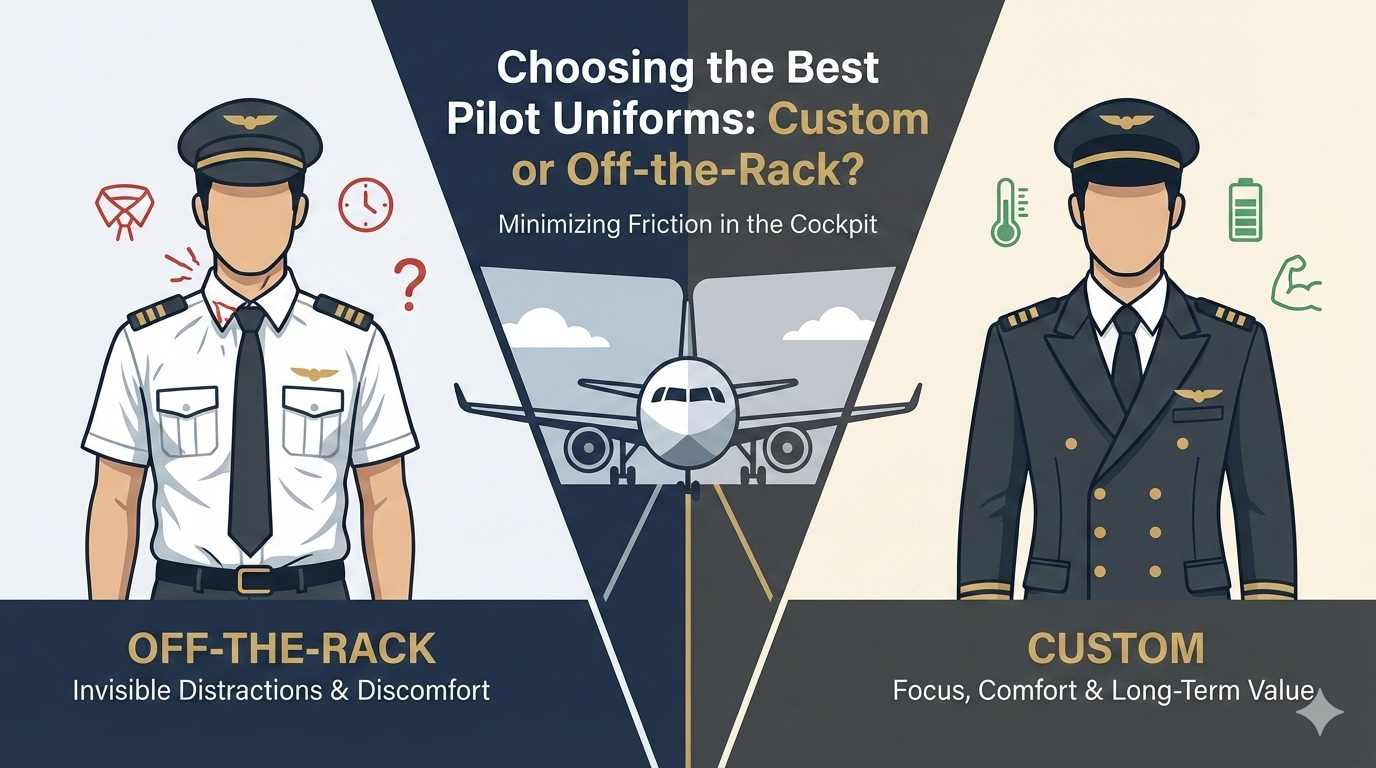
Introduction: The Uniform as Cockpit Equipment

As a matter of fact, most pilots do not think about uniforms until they begin to annoy them. A tight collar. Sleeves that ride up. A waistband that digs in halfway through a long leg. These problems hardly show up on the first day. They come into the picture on FL350, during a crazy workload, when distractions matter the most.
This is the “invisible distraction”. Uniform woes are quiet, constant, and cumulative. During a four-day sequence or a long deadhead, what first felt acceptable becomes uncomfortable and ultimately exhausting.
Uniforms are more often than not treated as cosmetic. However, in reality, they are cockpit equipment. They affect:
- Heat management
- Fatigue over long duty days
- Mobility and reach
- Command presence in front of the crew and passengers
As for US pilots, there’s another reality: most airlines do not give uniform allowances. This is a personal investment that is paid out of pocket, especially very early in a career, when the budgets are always a little tight.
The real question is not whether “custom vs off-the-rack pilot uniforms look better.” It is about which choice eliminates friction, replacement cost over time, and distraction.
When Off-the-Rack Pilot Uniforms Work Well: The Entry-Level Strategy
The typical definition of off-the-rack uniforms is that they are the most practical option, especially at the start of any pilot’s career.
When to Choose Off-the-rack
- New hires and regional pilots who have training debt.
- During probationary periods, when body weight, schedules, and requirements are still evolving.
- Short-term projects or training cycles.
- Off-the-rack also fits the pilots who have standard body proportions. It roughly amounts to:
- 30-40% male pilots
- Fewer than 10% female pilots
For this particular group, mass sizing can be effective in avoiding major problems.
Why Airlines Rely on Off-the-Rack
- Quick compliance with uniform manuals.
- Consistent look for thousands of pilots.
- Fast replacement when something gets damaged.
Smart Entry-Level Approach
Many pilots use an off-the-rack shirt as a test phase to:
- Learn when discomfort shows up.
- Recognise collar, sleeve, and torso problems.
- See fabric performance during actual operations.
This learning phase allows the pilots to spend less time later on the wrong “custom” solution.
The Breaking Point: Where OTR Fails the Mission

Common Off-the-Rack Failure Points
Neck vs Chest Conflict
- Sizing up for collar comfort
- Outcomes in a loose, baggy torso
- Looks unprofessional and bunches under the harness
Reach Restrictions
- Standard sleeves ride up while using the overhead panel.
- Shoulder cuts restrict the movement of arms.
- Small problems occur hundreds of times during every trip.
Seated-Posture Troubles
- Waist pinch after hours of sitting.
- Shirts get untucked during long sectors.
- Circulation problems compound fatigue.
These are small issues. Separately, they might seem minor. However, combined, they increase cognitive burden during high workload.
The Female Pilot Reality
Off-the-Rack often fails women faster and more expensively:
- Masculine shoulder slopes
- Poor bust accommodation
- Incorrect torso lengths
The Outcome:
- A significant amount per shirt in alterations.
- Still not quite perfect.
- Have to repeat every 18-24 months.

Off-the-rack shirts are not bad, but they are not built to withstand airline uniform regulations.
Defining “Aviation Custom”: Engineering Fit for Cockpit Performance
“Aviation custom” is not bespoke tailoring. It's engineering clothing for a long-seated, active job.
What Aviation-Focused Custom Does Differently
- Designed for a 90-degree seated position.
- Takes into account reach, harness use, and rotation.
- Prioritizes mobility over fashion.
Feature-Driven Customization
Performance Benefits of custom-tailored uniforms:
- Collar relief for long wear.
- Arm-mobility gussets.
- Clean midsection lines under a five-point harness.
- Extended torso length to eliminate untucking.
EASA/FAA standards Compliance Matters
- Custom uniform pilot shirts must also meet the airline's rules and regulations.
- Exact color shades.
- Correct epaulet widths.
- Proper pilot rank insignia placement.
Industry Example: BomCrewMall
Aviation-centered brands like BomCrewMall build pilot uniform shirts around cockpit realities:
· Best materials for pilot uniforms, like Pegasus fabric, poly bamboo
· V-tapered athletic cuts (broad shoulders, lean waist)
· Extended torso choices
- Airline-compliant colors and trims
Built for the cockpit. Worn by pilots. BomCrewMall.
Their approach strikes a balance between performance fit and strict uniform manuals, which is where many generic brands fail.
The Flight-Hours ROI: Cost, Friction, Durability, and Longevity
Off-the-rack shirts might look cheap on the face, but long-term math shows a different picture.
Cost Comparison: Custom Vs Off-the-Rack

Real-World Math
- Off-the-rack: $ 520-$800 per shirt position over time.
- Custom: $480-$1000, but with much less friction.
Hidden Costs of Off-the-Rack Shirts
- Alterations fees
- Discontinued styles leading to complete replacement
- Time spent reordering when traveling.
The “Alteration Tax” for Women
- $150-$200 per cycle
- Repeat every 18-24 months.
Why Specialists Matter
Brands like BomCrewMall eliminate churn by:
- Keeping patterns consistent
- Reinforced stitching and durable buttons
- Making reorders predictable, eliminating measuring, and tailoring process
With pay increasing at major carriers, pilots are shifting from survival budgeting to performance and durability thinking.
The Hybrid Approach: Where Most US Pilots End Up
Most pilots do not pick one path forever; they evolve.

Typical Career Progression
Year 1-3: Entry Level
- Off-the-rack foundation
- $500-$700 complete spend
- Concentrate on factors influencing the decision (airline, rank, fit)
Year 3-5: Transition
- Add 1-2 custom “uniform-shirt pieces.”
- Usually shirts or a blazer
- Validate comfort and durability.
Year 5+: Established
- Mostly custom pilot uniform shirts
- Off-the-rack backups only for emergencies.
The Hero Piece Strategy
- Invest in custom shirts because they matter most.
- Keep off-the-rack trousers for high wear and spills.
Emergency Readiness
- Every custom shirt pilot must have 1-2 off-the-rack shirts for last-minute replacements.
Eliminating Friction Long-Term
Pilot first brands like BomCrewMall support this approach with:
- Saved measurement profiles
- Quick and easy reorder from anywhere.
- Turnaround time for tailoring across years
This hybrid approach model balances comfort, budget, risk, and compliance.
Fly Distraction-Free with BomCrewMall Custom Pilot Shirts
Conclusion: Efficiency Through Personalization at FL350
There is no one right answer, only the right choice for your operations, career stage, and body type. Uniform fit is not just about style; it’s about eliminating fatigue, friction, and distractions over thousands of flight hours. So, to be cockpit-ready always, choose BomCrewMall custom pilot shirts and pay minimal effort or uniform maintenance and care.
Frequently Asked Questions
Are Custom Plot Shirts Allowed on US Airlines?
Yes, if they adhere to airline uniform manuals. BomCrewMall custom pilot shirts take into consideration these regulations before making these shirts.
Does the FAA Regulate Pilot Uniform Fit?
No, the FAA wholly concentrates on pilots’ safety and security. It does not pay attention to the appearances of the pilots.
Do Poor-Fitting Uniform Shirts Affect Cockpit Performance?
Yes, discomfort with uniform shirts increases the load on your mind and also leads to fatigue. So, it is pertinent to wear fitted custom pilot shirts to avoid these problems.
How Can Pilots Get Measured While Traveling?
To solve this problem, brands like BomCrewMall use remote guides and virtual fittings for pilots while they are busy traveling.
Which Choice Costs Less Over a Period of 15 Years?
Custom pilot shirts often cost less because they require fewer replacements and alterations over a period of 15 years.