
Airline Pilot Uniform Guide
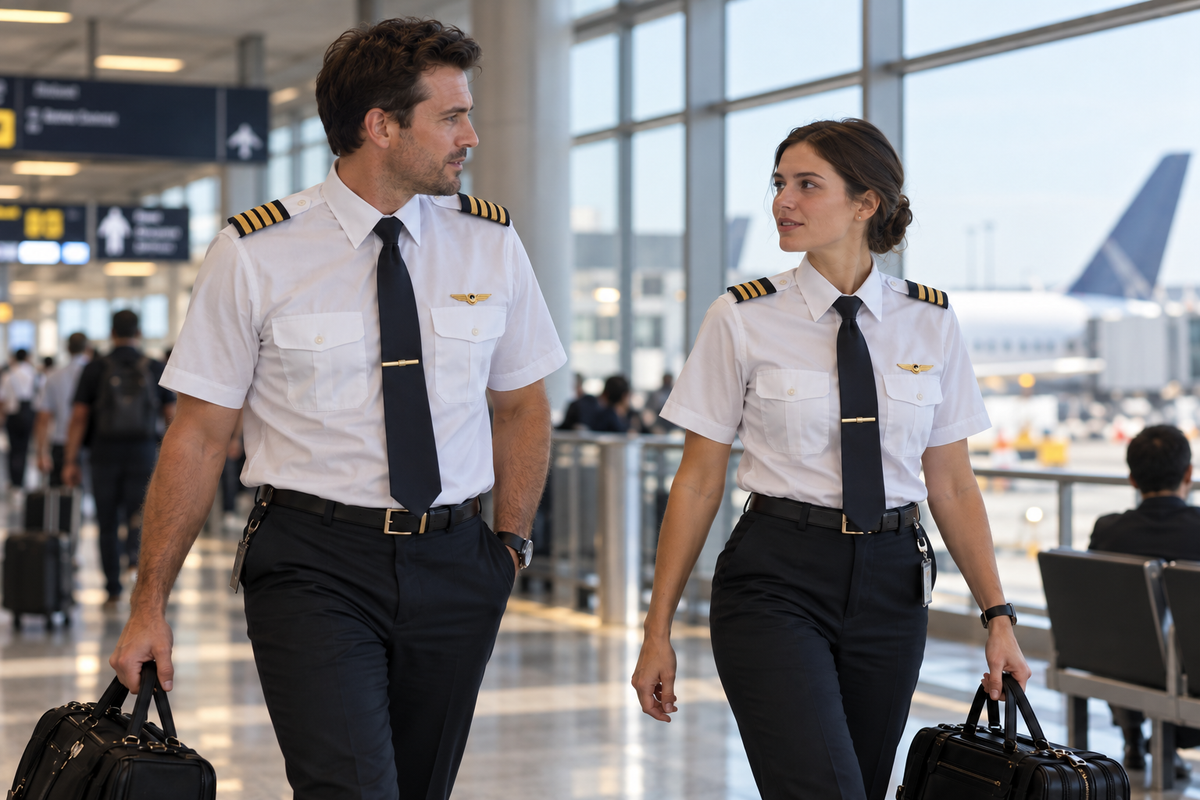
The quintessential pilot stands out from the huge crowds seen on any major airport from miles away. The silhouette itself is iconic: pale shirt, dark tie, stripes on each shoulder, a flight bag trailing behind. Most guides describe the pilot uniform as a look. We would argue it is closer to a signaling system, because passengers, gate agents, security staff and ground crews all read rank and authority from the shoulders in about two seconds.
So what do airline pilots wear? A US airline pilot typically wears a uniform shirt with epaulettes, a dark tie, dark trousers, wings and a name badge, with a jacket and cap added at some airlines. No single national specification exists. Each airline writes its own uniform manual, which is why the answer shifts from carrier to carrier, and why much of what you read online is only approximately true for your airline.
The Airline Pilot Uniform at a Glance
Eight components make up the standard airline pilot outfit, although the exact specification belongs to the operator.
-
The shirt: usually white, with shoulder straps for epaulettes and a pocket that takes a pen.
-
Epaulettes: stripes that denote rank, worn on the shoulder straps.
-
The tie: dark and plain.
-
Trousers: black or navy, matched to the jacket.
-
The jacket or blazer: anything from a plain dark jacket to a double breasted blazer with rank braid on the sleeves.
-
The cap: a peaked cap carrying the airline badge, now optional at many carriers.
-
Wings and name badge: worn on the chest.
-
Shoes and belt: black and polished.

The Uniform Shirt: The Piece That Does the Most Work
Of the eight, the shirt is worn for the entire duty day, in every season, under every other layer. It is also the piece most pilots underinvest in. White remains the default, a convention that traces back to the naval style on which the early airline uniform was modeled, although some operators specify other shades, so your manual decides.
Look for shoulder straps built to accept epaulettes, a pocket configuration that suits how you carry a pen, and a fabric that’s durable enough to effortlessly take you through a 0500 report followed by a hotel steam shower. Our white pilot shirts are built around those requirements, and how they differ from a department store shirt deserves its own post, which is Pilot Shirt vs Regular Dress Shirt. If you are weighing lines, fabrics and fits, How to Choose a Pilot Shirt walks through the sequence, and Best Pilot Shirts collects the options.

Epaulettes and Stripes: Reading Rank From the Shoulder
Epaulettes attach through the shoulder straps built into the uniform shirt, and the number of stripes denotes rank. The common convention at most airlines is four stripes for a captain and three for a first officer. Two stripes mark a second officer or flight engineer at carriers that still use the position, and one often marks a pilot in training. Exceptions exist: some airlines issue three stripes to a senior first officer and two to a junior one, so treat the table as the common pattern rather than a law.
|
Stripes |
Typical meaning |
Note |
|---|---|---|
|
4 |
Captain |
Command of the aircraft |
|
3 |
First officer (senior first officer at some carriers) |
Second in command |
|
2 |
Second officer, flight engineer, or junior first officer at some carriers |
Varies by operator |
|
1 |
Pilot in training or cadet |
Rare on the line |
Epaulettes are typically sold separately from the shirt and are detachable, which makes it so that a pilot who uses several shirts needs only one pair. Browse pilot epaulettes once your airline confirms the specification.

Tie, Trousers and Belt
Plain and dark. A dark tie, black or navy trousers matched to the jacket and a black belt. The restraint is deliberate; this part of the uniform exists not to be noticed. Cut still matters, because trousers that bunch at the knee after a four hour cruise are noticed by their wearer long before anyone else.
The Jacket or Blazer
Jackets range from a simple dark blazer to a double breasted version with rank braid on the sleeves, depending on the operator. Manuals commonly specify when the jacket is worn, usually in public view and in the terminal, and most pilots hang it up once they are seated on the flight deck.
The Cap: Fading, Not Gone
The peaked cap is the most debated piece. The Air Line Pilots Association has said the rule is set airline by airline, with some manuals still technically requiring it, and American and United have both made it optional. Read your manual. Do not assume.
Wings, Name Badge and Accessories
Wings and a name badge sit on the chest, and the operator prescribes the arrangement. A watch, a pen and a flight bag are not uniform in the formal sense, but in practice they complete it. We cover the bag in What Airline Pilots Carry in Their Flight Bag.
Do All US Airline Pilots Dress Alike?
Short answer, No. The structure is shared, but the specification is not. Shirt shade, pocket configuration, tie, jacket style and cap policy are each written into a carrier's own manual. Cargo operators, regional carriers and the majors hold different standards, and a shirt that is correct for one fleet can be wrong for the crew at the next gate.
If you fly for one of the big names, our airline pages are organized around that problem: Delta pilot shirts, American Airlines pilot shirts, United pilot shirts, FedEx pilot shirts and UPS pilot shirts. If your airline is not on that list, browse all airlines.
What Do Women Pilots Wear?
The same components in the same order, with a different pattern. A women's pilot shirt is cut differently through the shoulder, bust and torso, and open collar options exist for carriers that permit them. For specifics, see Best Women's Pilot Shirts for Airline Uniforms, and for the fit logic, Why Do Women's Pilot Shirts Fit Differently? Sizing Explained.
Commercial Pilot Uniform vs Student and Private Pilot Dress
The phrase commercial pilot uniform means different things to different readers. A private pilot wears whatever suits the weather, because there is no uniform at all. Many flight schools dress students in a simplified version of the airline kit, a white shirt, dark trousers and a tie, to build professional habits early, and instructors often add wings. The full uniform described above is an employer's requirement, which means it begins the day you are hired rather than the day you earn a certificate.
Where the Uniform Comes From
The airline uniform borrowed heavily from naval dress, including the stripes and the cap. Pan Am set an early template of dark trousers, a blazer with rank stripes, an officer style cap and a badge, and the format has changed little since, even as individual airlines altered colors and cut.
Building Your Pilot Uniform Kit
Pilot clothes are an equipment question before they are a style question, and three habits matter. First, rotate at least three shirts, so that wear is spread across all of them and none ages out alone. Second, buy to your airline's specification rather than to the nearest white shirt, because a rejected shirt is a wasted shirt. Third, settle fit before fabric. Collar, tail and sleeve length decide whether a shirt stays tucked through the day, which we explain in Why Choose a Custom Pilot Shirt Over a Standard One.
BomCrewMall has made shirts for pilots since 1991, every order is backed by a 100% fit guarantee, and when you order three or more we send a single mock shirt for approval before the rest is made.
Frequently Asked Questions
Why do airline pilots wear white shirts?
Mainly convention, inherited from the naval style the airline uniform copied. White also reads as formal and keeps the epaulettes legible. Airlines can and do specify other shades.
What do the stripes on a pilot uniform mean?
They denote rank. At most airlines, four stripes mean captain and three mean first officer, with two for a second officer or flight engineer and one for a trainee. Operators vary.
Do airline pilots have to wear hats?
It depends on the airline. The rule is set carrier by carrier, several large US airlines have made the cap optional, and some manuals still technically require it.
Can airline pilots wear their own clothes?
Generally not on duty. Dress standards are employer policy, and the manual spells out what is authorized. Private pilots have no uniform requirement.
Briefing Complete
A pilot uniform is a short grammar: shirt, shoulders, tie, trousers, wings. Each piece says something to someone, which is why the details are specified so closely and why getting them wrong is noticed so quickly. Read your manual, buy to it, and start with the piece that works hardest. Browse our pilot shirts.