
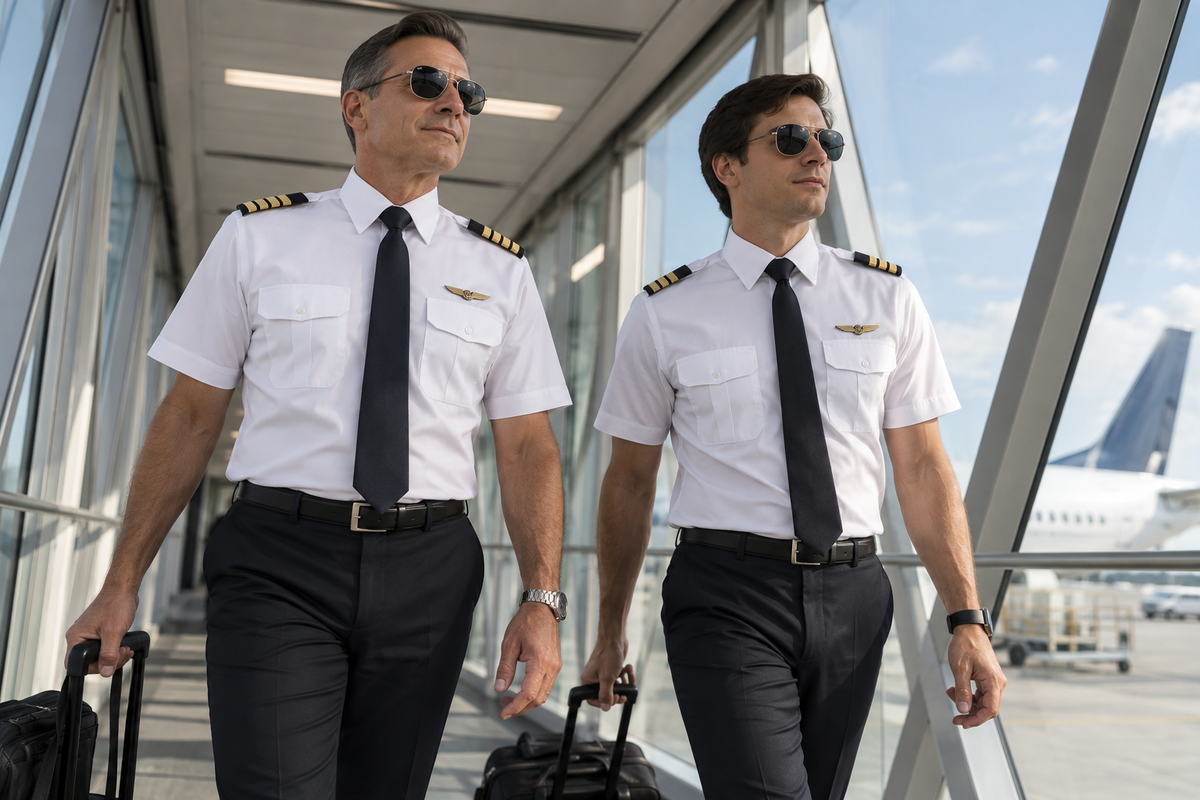
Stand next to enough captains at a gate and you will eventually notice that the ones whose uniform looks sharp after a fourteen-hour duty day are not wearing anything special. The key is that they are wearing something that fits perfectly, going beyond the size on the tag. Something that fits, in the specific sense that a custom pilot shirt does and an off-the-shelf one usually does not, sometimes even if you’ve picked the perfect size. We’ve asked around long enough and most crews have told us that the best pilot shirt that’s served them was not off of a shelf.
Most pilots do not think about this until it becomes a problem. It starts slowly, with a collar that's choking them by the second leg or a hem that's worked itself loose before top of descent. Maybe even a sleeve cuff they’re having to reset every time they reach for the yoke. It starts happening three or four times a week, and eventually becomes enough of a problem that they start wondering to themselves: why choose a custom pilot shirt over whatever standard cut I’ve been tolerating? Here’s what a tailored pilot shirt actually solves that a standard simply isn’t built to.
The Body Doesn't Read a Size Chart
Standard sizing plays on the concept of averages, categorising on the frequencies of “this is close enough to where most bodies fall.” Fatally, it assumes a body that does not exist except on paper. It assumes symmetry, while most people are not symmetrical. One shoulder often sits marginally lower than the other. Humans arms are not identical lengths, which is common enough that tailors have a procedure accounting for it that manufacturers prefer to delegate to the aftermarket. A pilot with broad shoulders and a slim waist gets a shirt that is correct at the shoulders and baggy everywhere else, or correct at the waist and tight everywhere else, because a standard pilot uniform shirt is cut for one ratio (or “cut”) and one cut only.
Neck-chest variances also hurt a lot for something pilots have to wear every day. A pilot with a larger neck and a proportionally smaller chest either buys up for the collar and drowns in the body, or buys to fit the body and spends the day fighting a collar that refuses to close comfortably under a tie. Athletic builds suffer the same problem, being broader through the chest and back than a standard cut anticipates. The shirt pulls at the buttons even while sitting in a cockpit seat.

Height makes it all worse. Taller pilots can do naught but watch their shirts ride up and untuck through a normal day, not due to carelessness but because the shirt wasn’t designed to facilitate sitting down, standing up and reaching up to things dozens of times per shift. Shorter pilots can have it worse if their job requires fine motor control, with sleeves that need rolling, a hem that bunches, a garment that was clearly sized for someone taller and tests the patience of someone who isn't.
Most of all, human bodies change. A pilot who has gained or lost weight over a few years of line flying still needs to look like the same disciplined professional in the left seat, and a standard pilot shirt bought two sizes ago cannot accommodate that. A custom pilot shirt does, because it is built from actual pilot shirt measurements, not a chart's best guess at where you might land.
What "Correct Size" Actually Looks Like
Here is the uncomfortable truth: a shirt can be the technically correct size and still look wrong. This is something most pilots do not notice or care about until someone points it out, usually a spouse, occasionally a check airman.
Excess fabric around the waist bunches under the trouser line and creates a visible ridge that no amount of tucking fixes permanently. Sleeves that are engineered for an "average" arm either swallow the hand or stop well above the wrist, and there is rarely a middle setting that works. The collar, meanwhile, tends to fail in one of two directions: tight enough to choke by hour six of a duty day, or loose enough to gap visibly the moment a tie goes on. None of these are dramatic failures on their own. Together, across a full uniform, they read as untidy on a person whose job depends on projecting precision.
The best pilot uniform shirts do not have this problem, because they were never mass-produced against an average body in the first place. The same logic applies whether you're flying for a regional or a major: the best airline pilot shirts and the best pilot uniform shirts in general are built around this exact failure point, not around it being acceptable. A genuinely professional pilot shirt holds its line under a jacket, under a headset strap, under a full duty day, which is a different bar of quality than meeting the bare minimum checklist.
The Duty Day Doesn't Care About Your Uniform

Ten to fourteen hours is a long time to wear anything, and it is an especially long time to wear something that fights you. High quality pilot shirts earn that description precisely here, in the hours nobody's watching, not in how they look for the first thirty minutes of a duty day. Tight shoulders that felt fine at 0500 become a genuine discomfort by the third sector. A collar that closes comfortably before departure tightens its grip, or at least feels like it does, somewhere around hour eight with a tie still cinched. Sleeves that restrict shoulder movement turn cockpit checks into small, repeated annoyances, the kind that don't ruin a flight but accumulate across a month of them.
Sitting compounds the waist problem specifically. Excess fabric that looked fine standing at the gate bunches uncomfortably the moment a pilot is seated for four hours straight, and there is no adjusting your way out of it mid-flight. What ends up happening instead is a quiet, constant ritual of pulling the shirt back into place, which is not what anyone signed up for when they chose this career.
None of this is about vanity. It is about comfort holding up under the specific, repetitive physical demands of the job, which a wrinkle free pilot shirt in the wrong cut cannot deliver no matter how well the fabric performs.
A shirt fitted for sitting still is not the same as a shirt fitted for the actual job, and airline work is rarely stationary. Pilots walk terminals, climb stairs, lift bags into overhead bins, and perform walk-around inspections in weather that ranges from pleasant to genuinely hostile. A shirt that sits correctly while seated can pull sharply across the back or chest the instant someone reaches overhead, which is precisely the motion a walk-around and a pre-flight inspection both require repeatedly.
Better mobility here is not a luxury feature. It is the difference between a shirt that lets you do the physical parts of the job without thinking about your uniform and one that reminds you of its limitations every time you extend your arms. A properly built airline pilot shirt holds its shape and stays presentable across multiple sectors precisely because it was cut with that range of motion in mind from the start, not retrofitted to accommodate it afterward.
Interviews, check rides, and promotion boards are the handful of days across a career when a training captain or an interview panel is actively evaluating bearing alongside technical skill, and a shirt that’s built for them is one of the few variables in that room that a pilot controls.
The Math on Alterations Doesn't Work Long Term
A common solution to the problems we’ve been talking about is buying a standard shirt, then paying a local tailor to shorten the sleeves, taper the waist, or take in the body. It works, sort of, and it costs money every single time, for every single purchase, indefinitely. The worse tradeoff is probably time, however, as that is even harder to earn back.
Alterations also have a ceiling. A tailor can shorten a sleeve. A tailor cannot fully correct a shirt engineered around the wrong proportions from the pattern stage onward without unpicking and rebuilding more of the garment than the alteration budget usually allows. The result is a shirt that is closer to right, at additional and recurring cost, rather than a shirt that was built for you.
A custom tailored pilot shirt starts from the pilot's actual measurements instead of correcting a generic pattern after the fact. Buying a genuine made-to-measure shirt the first time removes the alteration step entirely, since there's no generic pattern to correct in the first place. The cost comparison only looks close if you ignore that alterations are a repeating expense and a proper custom uniform shirt is a one-time decision that then repeats correctly, order after order.
Fit Is Only Half the Decision. Preference Is the Other Half

Body measurements solve the objective half of the problem, which is what a custom tailored pilot shirt is built to handle in the first place. A pilot work shirt has to perform under conditions no off-the-rack designer accounted for, and that's exactly where these small preferences stop being cosmetic and start being functional. The other half is entirely subjective, and standard sizing has no mechanism to address it at all.
Some pilots want a slimmer, more modern cut. Others want room to move and would rather have a relaxed fit that doesn't announce itself. Some prefer extra ease around the stomach specifically because long duty days are more comfortable that way. Sleeve length is its own argument: some pilots want them ending precisely at the wrist, others prefer a bit longer. Shirt tail length matters more than it should for a garment nobody sees once it's tucked in, mostly because a longer tail means it stays tucked through a full duty day instead of working itself loose by the second sector. Collar preference splits pilots cleanly down the middle too: some want it snug for a sharp, formal look, others want breathing room and don't care if it reads slightly looser. Cuff style and pocket configuration round out the list of small decisions that a standard shirt simply does not offer, because offering them at scale isn't commercially viable for mass production.
None of these preferences are about function in the strict sense. They are about a pilot deciding, deliberately, what their uniform should feel and look like, rather than accepting whatever a size chart assigned them.
When a Standard Shirt Is Still the Right Call
Strip away the aviation context and made to measure vs ready to wear is a decision people make across every category of formalwear, and pilots run into it more acutely than most professions simply because the uniform is worn on every single duty day, for years, rather than occasionally. Small fit problems compound at that frequency in a way they never would in a shirt worn once a week, and that repetition is why the calculation tips toward custom for so many pilots once they've actually done the math on how many duty days a single shirt gets worn.
None of this means every pilot needs a custom shirt, and it would be dishonest to argue otherwise. If a standard shirt already fits well, if it's needed on short notice, or if the budget doesn't support custom right now, a ready to wear pilot shirt or a basic ready to wear shirt off any airline uniform supplier's shelf is a perfectly reasonable choice, and plenty of pilots fly entire careers in shelf-bought airline uniform shirt options without a single complaint.
The honest version of this argument isn't that a ready to wear pilot shirt is bad. It's that standard shirts are built for an average that describes almost nobody exactly, and the pilots who notice the gap between "technically the right size" and "actually fits" are the ones asking is a custom pilot shirt worth it, usually after the fifth or sixth time they've had to pull a shirt back into place mid-shift. For most of them, once they've flown a custom pilot shirt for airline pilots built to their own numbers, the standard version stops being a serious option.
Where BomCrewMall Fits Into This

BomCrewMall builds custom pilot shirts from individual measurements rather than a generic size run, covering the fit variables outlined above: shoulder asymmetry, arm length, neck-to-chest ratio, waist taper, sleeve length, and shirt tail length, alongside the styling choices, collar fit, cuff style, and pocket configuration, that come down to personal preference rather than body shape. If you've been asking how a pilot shirt should fit, our answer is that it should fit like it belongs on your body.
The range includes options across pilot shirts with epaulettes, tailored specifically for airline-standard rank presentation, and premium pilot shirt fabric choices built for the realities of a long duty day, including breathable pilot shirt and durable pilot shirt options for pilots who need a wrinkle free pilot shirt that holds its shape from report time to block-in. It's built to be, plainly, the best custom pilot shirt option for a pilot who's done comparing and is ready to order based on their own fit and finish.
For pilots deciding between a full custom build and a standard shirt, our detailed Custom Pilot Shirt vs Standard Pilot Shirt comparison breaks down the specifics feature by feature. If you already know custom is the direction you want, our Pilot Shirt Size Guide and Collar Size Guide walk through exactly how to take accurate measurements at home, and our Fabric Guide covers the material differences that affect comfort and durability across a full career of duty days.
All custom pilot shirt USA orders ship backed by our 100% Fit Guarantee, and custom pilot shirts shipped across the USA arrive ready to wear on your own fit and style. Whether you're looking for the best pilot shirt for airline pilots flying wide-body internationally or a regional first officer building a first kit, the fit process is seamless, and one time.
We like to go the extra mile and ensure that by ordering from us, you won’t have to waste precious time and money trying out different sizes to compromise on, or ever visit a tailor. We remember the information you give us, so future orders are easier to adjust to body changes and always fit right the first time.
Browse the full Custom Pilot Shirts collection or explore our White Pilot Shirts for the most requested base color across every fleet.