
Why Do Women's Pilot Shirts Fit Differently? Sizing Explained
A women's pilot shirt can carry precisely the right size label and still feel horrible to wear, because there are three separate tests that it must pass: how it looks, how it works, and how it feels by the tenth hour of a duty day. These failures are very common, unfortunately, and they trace back to a handful of measurements that one size and fit doesn’t reconcile. We hope by the end of this article you’re able to figure out which measurement is misbehaving, because knowing is half the battle.
The root cause is unglamorous: unit economics. Women's pilot shirt sizing is built by a process called grading, wherein a manufacturer draws a single base pattern and scales it by fixed increments, resulting in the fatal assumption that shoulders, bust, waist, sleeves, and torso grow in tidy proportions for each fit. Bodies are under no obligation to cooperate to the mass-market whims, and the wearer ends up building a slow hatred of the shirt over its lifespan for it.
Five women's pilot shirt measurements that refuse to move together
A shirt has to satisfy shoulder width, bust, waist, sleeve length, and torso length at once, and these dimensions may vary independently. A woman can be a medium across the shoulders, a large through the bust, a small at the waist, and long in the torso even before any questions of preference and type of fit arise. The size labels seen online usually report only on one of those facts (maybe two if you’re lucky) and quietly discards the rest: pointing you to a sizing chart and constantly cross-checking to get anywhere. The charts and labels, or the grading as we called it earlier, also varies between manufacturers, so the same "medium" can correspond to different garment measurements.
Shoulders matter the most, because that’s the one place where incorrect sizing is impossible to hide. Fabric can be taken in at the waist or let out at the hem, but the shoulder seam either fits the length of the shoulder or it does not, which makes the entire sleeve look and feel worse.
This is a well-known problem in the larger world of fashion. Many boutique stores prefer to have trial rooms and physical presence instead of an online storefront, and while most of those reasons have to do with being able to immerse the shopper in thousands of designs in a labyrinth of their making, being able to try something before you buy is the one aspect of a physical store that few online experiences match. This problem is exacerbated by the fact that the average shopper is not a pilot, so physical stores dedicated to pilot shirts are unfeasible economically. Our brand is dedicated to fixing that, but we’ll discuss that later.

Why women's pilot shirts need different sizing, not just smaller sizing
Uniform shirting descends from menswear, and the laziest route to a "women's" version is to shrink the pattern. The result is a smaller box, not a different shape. The best women's pilot uniform shirt is built from the ground up, with the conscious recognition that the bodies differ fundamentally:
| Construction point | Scaled-down men's pattern | Idea Women-specific pattern |
|---|---|---|
| Body shaping | Straight box | Darts or princess seams at bust and waist |
| Side seams | Straight drop | Curved to follow the torso |
| Shoulder | Wider, flatter slope | Narrower, with a steeper slope |
| Armhole | Larger and lower | Higher and smaller, so the hem stays put when the arm rises |
| Button placement | Set without reference to the bust | Positioned to limit gaping |
No amount of size selection cures a placket that was never positioned for the body. That is why two shirts with identical measurements on paper can behave nothing alike once they are worn. That is also why, as a custom pilot shirt company, female pilots hold a special priority in our catalogue.

The look: shoulders, epaulettes, and the line of the chest
Appearance is where a mismatch announces itself most loudly, and the reason is not vanity. A pilot shirt carries rank insignia, and insignia sit on a fixed frame. When the shoulder seam drifts past the natural edge of the shoulder, the epaulettes tilt, the chest line sags, and the whole upper body looks untidy regardless of the care with which the shirt was laundered and worn.
Why sizing up or down only relocates the problem
Sizing up buys chest room but lowers the shoulder seam and lengthens the sleeves. Sizing down restores the shoulders and then strains the bust, producing the pinched gape between buttons. You have exchanged one visible flaw for another, at the same price.
The sleeve in the coffin
A cuff that swallows the wrist looks borrowed, like a shadow of itself, whereas one that ends near the wrist bone looks tailored and in control. The difference between them is sometimes a single centimeter.
[image 4: end of the look section, alt-text="Close-up of a pilot shirt shoulder seam and epaulette, one sitting at the edge of the shoulder and one slipping past it", Shot note: split close-up of the same shoulder in two shirts, well-fitted on the left, oversized on the right. Tight crop from collar to upper sleeve with the epaulette centered.]
How to Fit-Check a Women's Pilot Shirt for the Cockpit
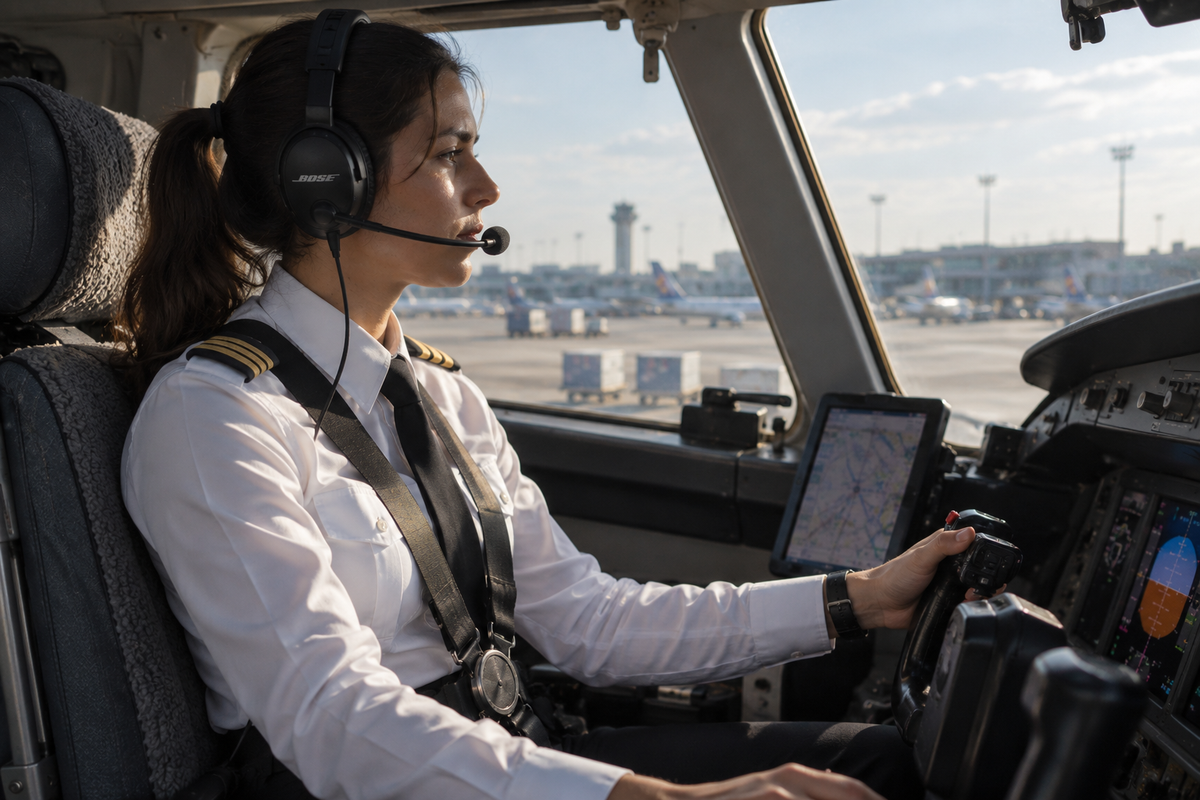
A shirt is normally judged in a mirror, standing still, arms at the sides. That is the least demanding posture it will ever endure. A working pilot sits for hours beneath a harness that crosses the chest, reaches overhead and across the pedestal, and wears a headset that drags at the collar line. A shirt that looks immaculate in the hotel mirror is being examined for an Instagram story, when it should be examined for a life of service.
Here are a few simple things anyone can try to see if their shirt is sized right for their body.
Test 1: The Overhead Reach
- Tuck the shirt in properly.
- Stand or sit upright.
- Raise both arms straight overhead.
- Watch the hem, the side seams, and the armpits.
- Then reach one arm across your body, as if tuning a radio.
What the results mean
- If the hem climbs out of the waistband when you raise your arms, the armhole height is likely incorrect. It may be too low or too deep for your torso.
- If the side seams pull upward toward the armpits, the shirt is probably relying on the hem for movement. That is never a good sign in a cockpit.
- If the armpit pinches or the shirt cuts into you, the armhole may be too high or too shallow.
- If the shirt stays mostly tucked and the armhole does not bind, it passes this test.
Test 2: The Seated Tuck
- Tuck the shirt in.
- Sit as you would in the cockpit: back against the seat, hips flexed, knees bent.
- Reach overhead, forward, and across your body.
- Check whether the hem stays inside the waistband.
What the results mean
- If the hem escapes every time you reach, the torso length is too short. You will be re-tucking it several times per leg.
- If excess fabric gathers or balloons under the belt, the torso length is too long. When seated, that extra fabric becomes bulk exactly where you do not want it.
- If it stays tucked with enough slack to move but no pile at the waist, the torso length is right.
Test 3: The Harness and Cross-Pedestal Reach
- Put on your harness, or simulate it with straps crossing your chest.
- Sit down and tighten it as you would in the cockpit.
- Reach across to the opposite side and down toward the pedestal.
- Turn your head as if scanning instruments.
What the results mean
Look for the following:
- Does the harness drag the collar or pull the shirt out of shape?
- Does the hem climb or escape?
- Does the armhole bind when you reach across?
- Does the shirt bunch under the straps?
If any of these happen, it becomes a small but persistent professional irritant. Airline grooming standards generally expect a neat, tucked presentation. A women's airline pilot shirt that refuses to stay put will need constant management. The same applies to any women's airline uniform shirt, though the cockpit makes the consequences unusually visible.
Test 4: The Headset and Collar Check
- Put on your headset.
- Turn your head left and right.
- Look down at the pedestal.
- Reach overhead.
If the headset drags the collar, pulls the shirt out of place, or makes the neckline gap, the shirt will not behave well during a long flight.
A good women's pilot shirt should pass the mirror test and the motion test. If it only looks good standing still, it is an Instagram shirt, not a working pilot shirt. If it stays tucked, does not climb, does not bind, and does not need constant adjustment, it is ready for the cockpit.

The feel: why the problem appears at hour nine
Discomfort in a badly fitted shirt is cumulative, which is why complaints tend to surface late in the day rather than at the first fitting. Fabric stretched across the bust is tolerable at hour one and tiresome by hour nine, particularly under a harness that presses it against the body. Excess fabric produces the opposite problem: bunching at the waist, sleeves that ride up at the elbow, and a collar that shifts every time the headset moves.
None of this is a dealbreaker immediately, and that is exactly the point. Nobody abandons a female pilot shirt over a single obvious failure. They tolerate a dozen minor ones until the shirt becomes the thing they notice most on a long day, when attention belongs elsewhere.
So, how should my pilot shirt fit?
The target state is easier to describe than to achieve. The shoulder seam sits at the edge of the shoulder. The buttons lie flat when you are seated. The hem holds when both arms rise. The cuff ends near the wrist bone. When those four conditions are met, the shirt is doing its job, whatever the label says.
Standard vs custom women's pilot shirt: when each makes sense
Do female pilots need custom shirts? Not necessarily, and it would be dishonest to suggest otherwise. Many find that a standard women's pilot shirt in their usual size meets all four conditions above without complaint, and for them additional spending buys nothing.
A custom women's pilot shirt earns its cost when the mismatch is consistent rather than occasional: two or more measurements sit in different size brackets, or repeated size changes and alterations have failed to converge. Even then, a tailor working on a well-chosen standard shirt is a legitimate middle path, and one worth trying first. Sleeve length, waist shaping, and hem are often adjustable. Shoulder seams and armholes rarely are, so a shoulder mismatch is the strongest signal that a different cut, not an alteration, is required.
If you want to compare cuts with those four conditions in mind, our range of women's pilot shirts is a reasonable place to start. Whether you are shopping for pilot shirts for women or diagnosing the one already in your closet, the useful question is never "what size am I?" It is "which of my measurements is the shirt getting wrong?"